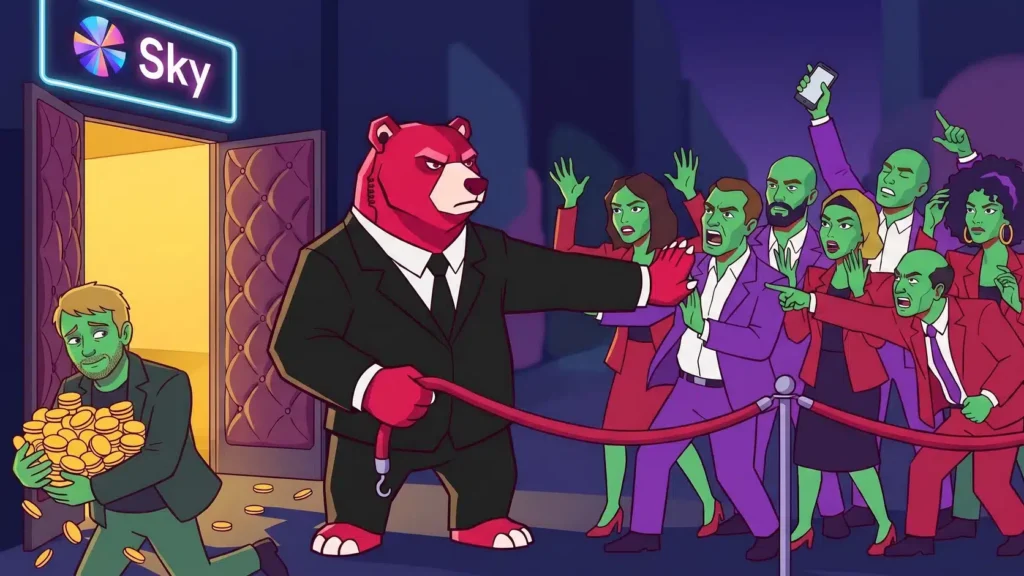
On Monday, November 23, 2026, Sky cofounder Rune Christensen said he still owed about 77 million USDS — Sky’s dollar stablecoin — from loans backed by his staked SKY, the protocol’s governance token. He wrote that the borrowing was “part of why stUSDS can’t withdraw today.” This is Unchained’s account of that Monday; the report appeared in the early morning of November 24, 2026, Hong Kong time.
Christensen posted on X at 8:39 a.m. Eastern Time. “This is on me,” he wrote. He said he had just repaid 3 million USDS and was “exploring options” to sell part of his SKY directly to institutional investors to cover the rest. He called the borrowing “a big mistake” and wrote, “I’m sorry.” He also said that “USDS is holding its peg.” That peg comment is his statement; the report does not include a separate price series.
Less than two hours later, Du Jun — whose X profile lists him as founder of Vernal Capital — quoted the post. He said he had sent Christensen a direct message and was “interested in buying your entire SKY position.” As reported, that was an expression of interest, not a completed sale. Christensen’s remaining balance and the 3 million USDS he said he had just repaid are stated separately here; the report does not give a combined total.
What the stuck exit actually measures
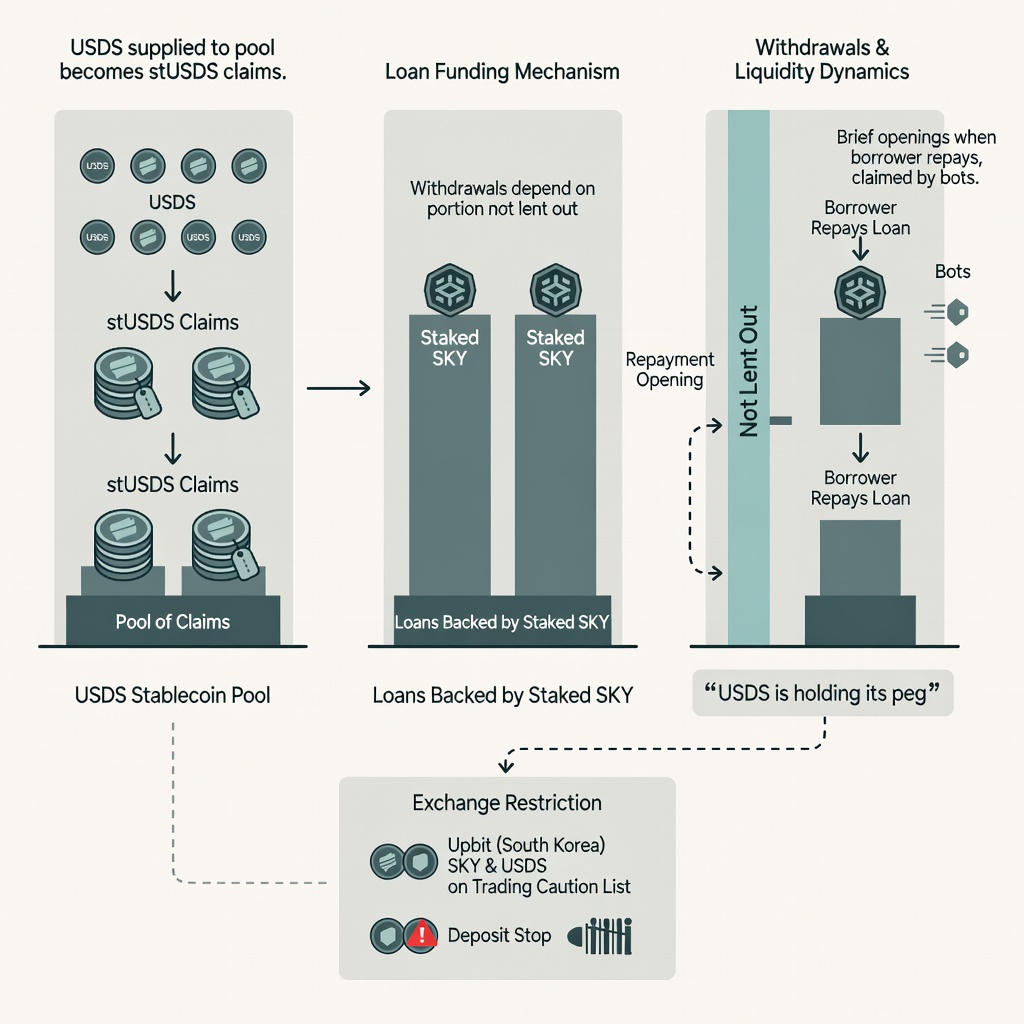
stUSDS is the token a depositor receives for supplying USDS to a pool that funds loans backed by SKY, according to Sky’s stUSDS page. Withdrawals depend on how much of that pool is not lent out. That is a liquidity condition inside one pool. It is not a count of users, addresses, or retained depositors.
By Unchained’s reading of the Ethereum contract, depositors’ claims on the pool totaled 158.7 million USDS at 2:47 p.m. ET on November 23. The figure is a stock of claims at one time. It does not say how many holders those claims belonged to, how long each claim had been locked, or what share of all USDS sat in stUSDS.
The freeze began before Monday’s post. On Sky’s governance forum that Monday morning, a depositor posting as ares wrote of being unable to withdraw “for over a week.” In the same post, ares wrote that holders can get money out only in the brief openings created when a borrower repays a loan, and that bots claim each opening almost at once. Those points are ares’s description of the exit path, not an enacted rule.
A supply decline without a baseline
Unchained had reported that Sky’s USDS supply fell by $2 billion in the week before this November 23 account. That is an absolute change in supply. This report does not give the starting amount, so it does not support a percentage, and it does not tie the decline to Christensen’s loan, to the stUSDS freeze, or to price.
Proposals, not a vote
stUSDS holders spent Monday arguing on the forum over a repayment plan. “Affiliated borrowers repay first,” ares wrote, asking that borrowers repay on a fixed schedule and that repaid money be shared in proportion to each holder’s stake. At 2:44 p.m. ET, a poster named Conquercube proposed that Sky spend $40 million to $50 million buying SKY directly from borrowers, off the open market, with the proceeds wiping out their debt.
None of the proposals had gone to a governance vote. No reply from Christensen or Sky’s core contributors appeared in the threads, and Sky had not commented that Monday beyond Christensen’s post, as far as Unchained could find.
Same-morning limit on exchange deposits
At 6 a.m. ET on November 23, hours before Christensen posted, Upbit in South Korea put SKY and USDS on its trading caution list and stopped accepting deposits of both tokens. The report describes that caution listing and deposit stop. It does not give trading volume, a user count, or how long the restriction would last.
What the Monday record supports is narrower than a judgment about Sky’s user base. A named founder said a large personal borrow was part of why one deposit token could not be withdrawn. A contract reading put pool claims at 158.7 million USDS at one afternoon timestamp. A depositor described repayment openings being taken almost immediately by bots. Two repayment ideas remained proposals. None of that measures retention, and none of it had become an enacted rule by the time of the report.