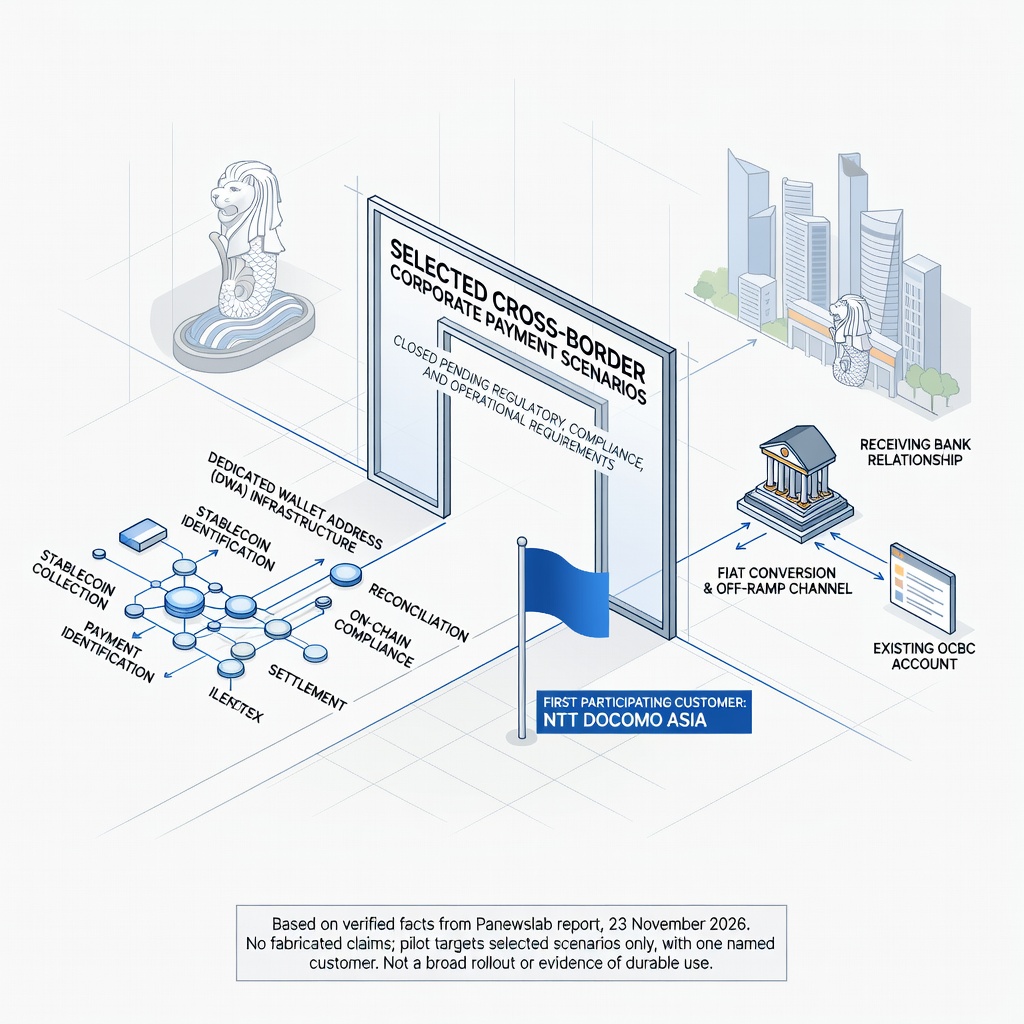
StraitsX announced on 23 November 2026 a cross-border corporate payments pilot with Oversea-Chinese Banking Corporation (OCBC), according to Panewslab. The pilot links stablecoin settlement to participating customers’ existing OCBC accounts. NTT DOCOMO ASIA is the first participating customer.
The arrangement is designed so that enterprises taking part do not manage the underlying stablecoin payment process themselves. StraitsX operates the stablecoin-side infrastructure. OCBC provides the receiving bank relationship and the fiat conversion and off-ramp channel.
One named customer, not a usage series
The report does not give a growth metric. It names no transaction count, settled value, address total, or customer base beyond NTT DOCOMO ASIA, and it sets no comparison window against earlier payment volume. On the facts given, this is a pilot of a settlement path, not evidence of durable corporate use, retention, or a broad shift onto stablecoins.
How the two sides split the work
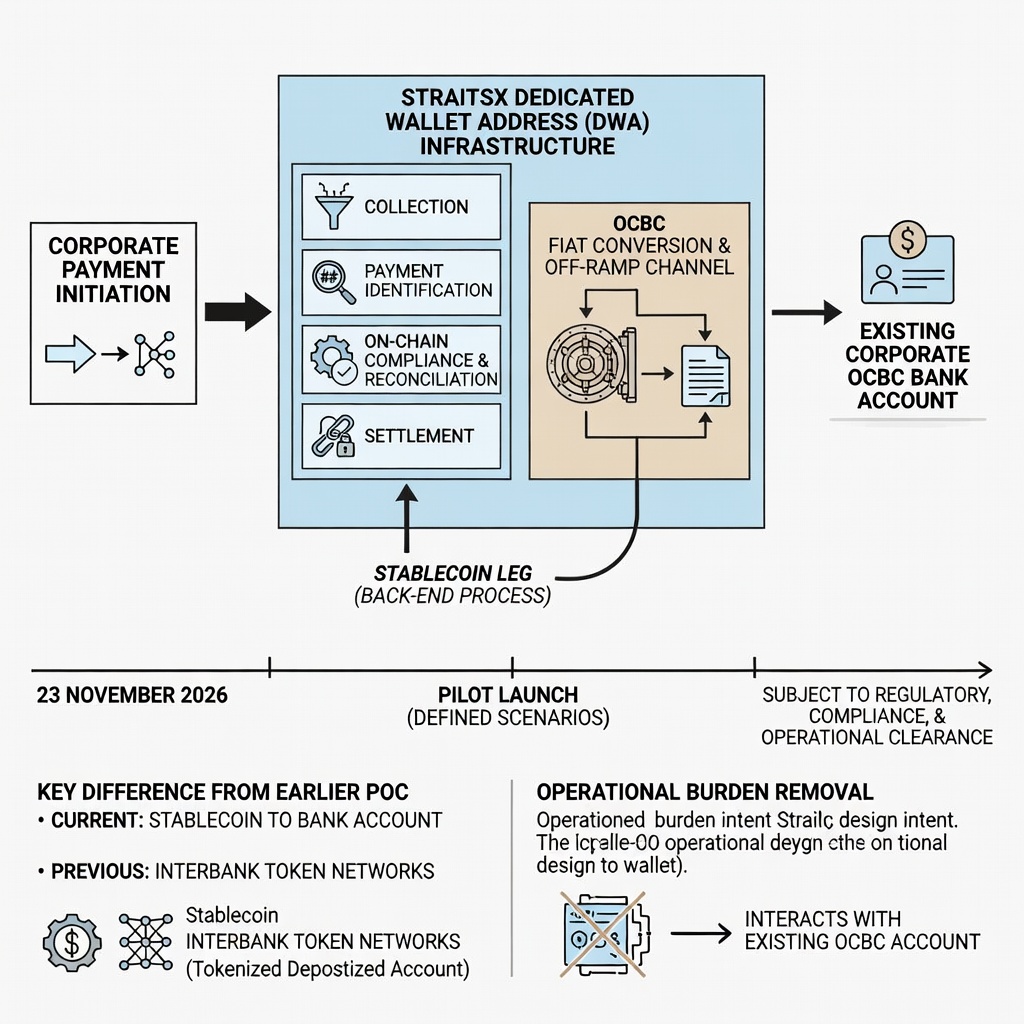
StraitsX’s dedicated wallet address (DWA) infrastructure handles stablecoin collection, payment identification, on-chain compliance, reconciliation, and settlement. OCBC holds the receiving bank relationship and the conversion and off-ramp that turns the stablecoin leg back into fiat for the enterprise.
Because of that split, a participating company is described as interacting with its existing OCBC account rather than with wallets, on-chain transfers, or reconciliation tooling. The stated purpose is to remove the operational burden of handling stablecoin payments in-house.
Panewslab reported that the pilot starts with a defined set of cross-border corporate payment scenarios rather than a broad rollout. Further progress is tied to applicable regulatory, compliance, and operational requirements. The pilot is not described as an activated, general service.
Different from the earlier bank-token test
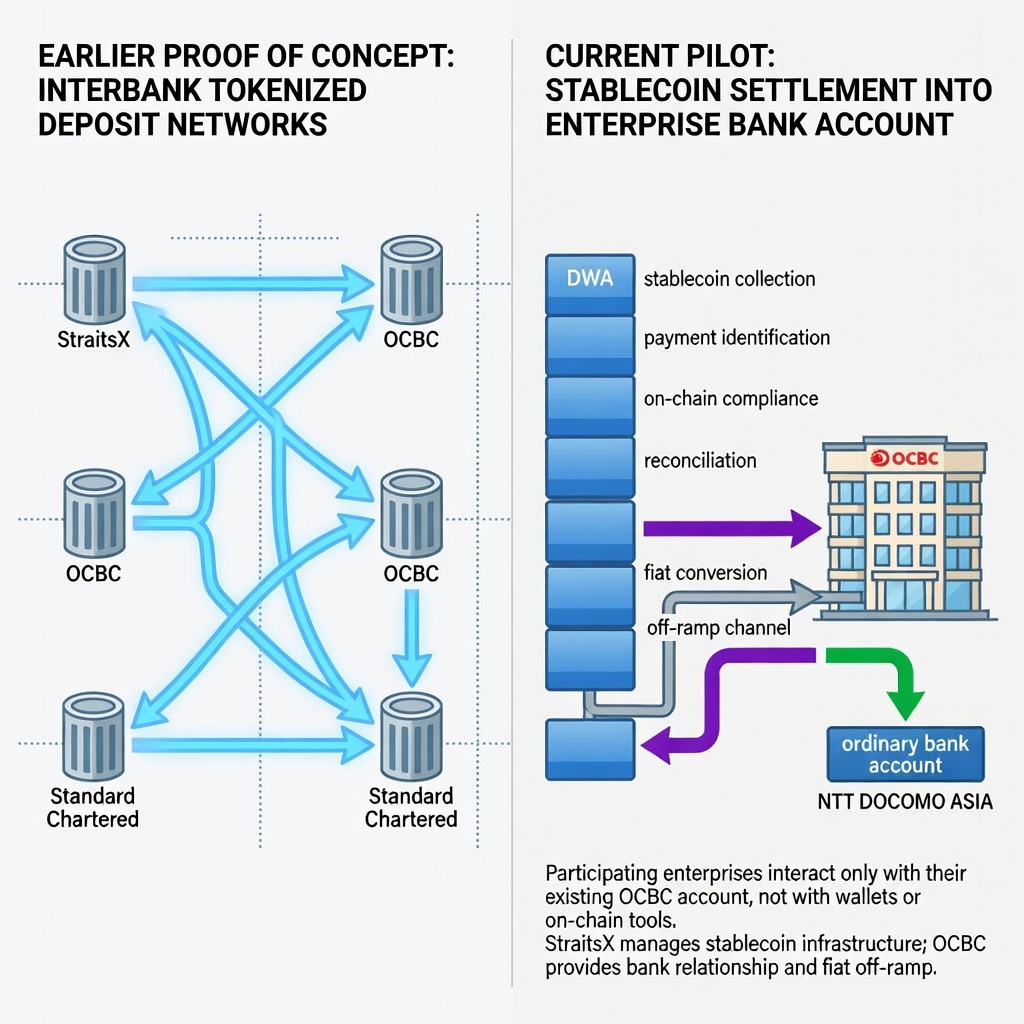
This pilot follows an earlier proof of concept involving StraitsX, OCBC, and Standard Chartered on interoperability of bank tokenized deposit networks. That exercise tested how tokenized deposits issued by banks could work across institutions.
The current arrangement moves the question from interbank token networks to stablecoins settling into a company’s ordinary bank account. The narrower problem, as framed in the report, is whether a stablecoin payment can be identified, checked, and reconciled on-chain, then converted and credited through a bank the enterprise already uses. The source does not name which stablecoin is used.
What the corporate test shows
For corporates, the pilot tests whether cross-border settlement can be handled without building a separate digital-asset treasury function. The stablecoin leg is cast as a back-end process inside the bank relationship — the part the report says most finance teams lack the staff and systems to run themselves. That is a claim about operational design, not a measured result on repeat use.
The report also places the pilot in an active policy stretch in Singapore, where the industry has been working through how stablecoins plug into regulated payment systems, including earlier reporting on Singapore’s plan to test stablecoin payments by AI agents. It presents a live corporate customer in a bank channel as a more concrete test of that question than a sandbox exercise. The evidence remains one named participant and selected scenarios, with wider use still conditional.
What would widen the reading
Because scope depends on regulatory, compliance, and operational clearance, the next signal the report flags is any guidance from Singapore’s authorities on how stablecoin settlement is treated in corporate payment channels. Also unresolved is whether OCBC and StraitsX disclose participating customers beyond NTT DOCOMO ASIA, or expand beyond the selected cross-border scenarios. Neither step is reported as done.