On November 11, 2026, at 20:29 (UTC+8), PANews published a TechFlow compilation of a Binance Research note by Kim Lim and Jasper Jin. The note uses a Capital Connect snapshot through October 31, 2026, plus interviews run from October 29 to November 1, 2026. It measures vehicles, fund counts, assets, and allocator preferences. It is not a count of users, wallets, or addresses, and it is not a statement that a higher bitcoin price equals adoption.
The scale gap is between vehicles, not a user census
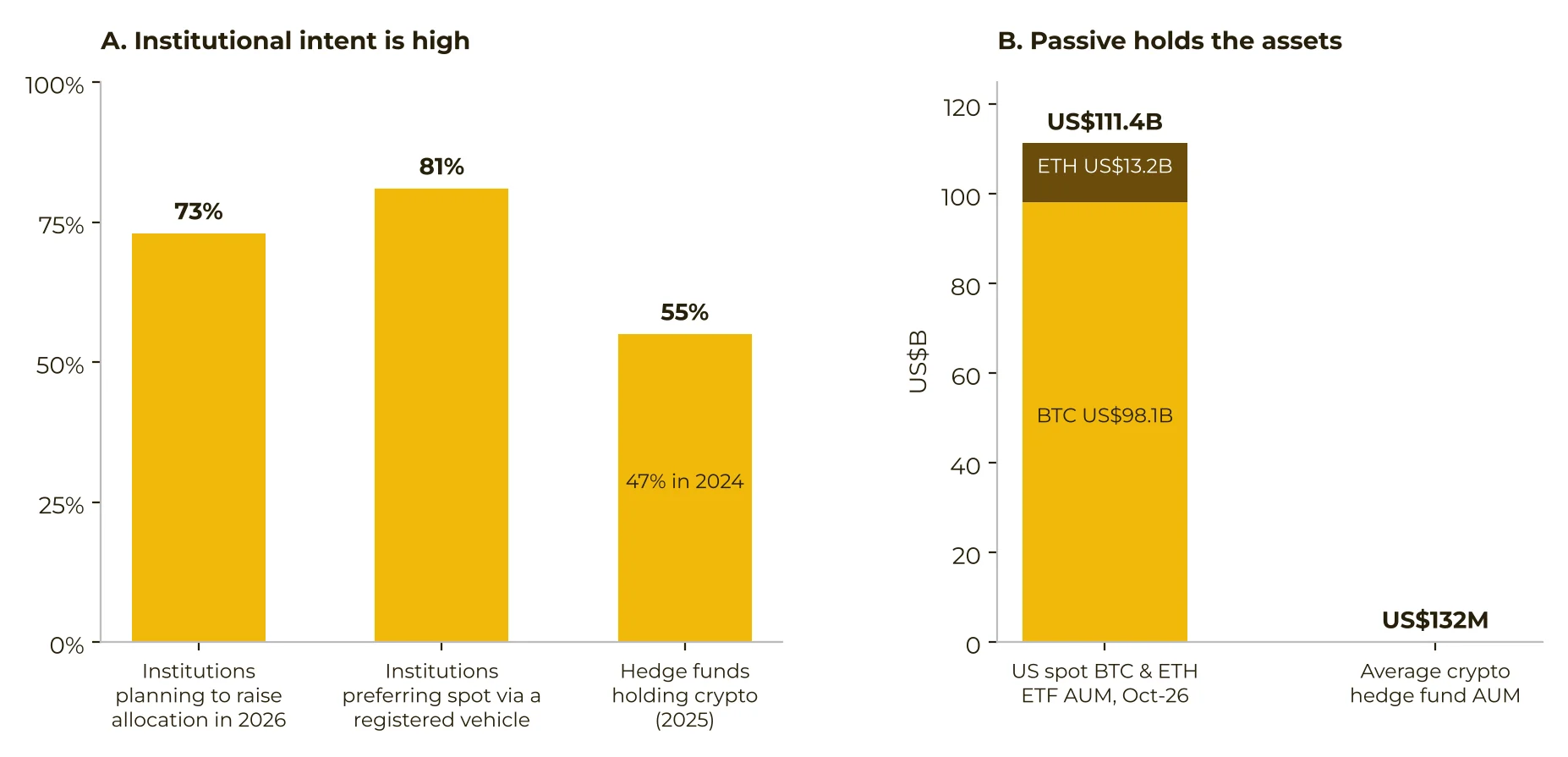
By the end of October 2026, US spot bitcoin and ether ETFs together held about $111 billion. Crypto hedge funds, in the comparison the note draws, averaged $132 million in assets under management, and 91% were smaller than $1 billion. The cited inputs for that framing are the EY-Parthenon and Coinbase institutional survey, the AIMA and PwC global crypto hedge fund report, a State Street digital-asset survey, SoSoValue, and Binance Research, with the ETF and fund-size comparison dated through October 31, 2026.
Those are different denominators. ETF assets are a pooled total for two US spot products. The hedge-fund figures are an average size and a share of funds under $1 billion, not a summed industry AUM and not a count of investors.
Stated intent mostly pointed at registered spot products
EY-Parthenon and Coinbase’s 2026 joint survey found that 73% of institutions planned to raise their digital-asset allocation that year. AIMA and PwC reported that 55% of traditional hedge funds held crypto assets, up from 47% in 2024. Among surveyed institutions, 81% preferred spot exposure through registered, compliant products.
The authors’ interpretation — not a separate measurement — is that this split reflects market infrastructure rather than a shortage of managers. They argue that ETFs packaged custody, audit, daily net-asset-value marks, and reporting institutions already knew, while active crypto strategies had not offered the same degree of institutional integration.
Sleeve size shows the limit on what “holding crypto” meant. Among traditional hedge funds that held crypto, more than half allocated less than 2% of total assets. Separately, 60% of institutions planned to lift exposure above 2% within a year. A plan is not completed allocation. The note does not show whether those plans were later carried out, or whether any increase went to active funds rather than spot products.
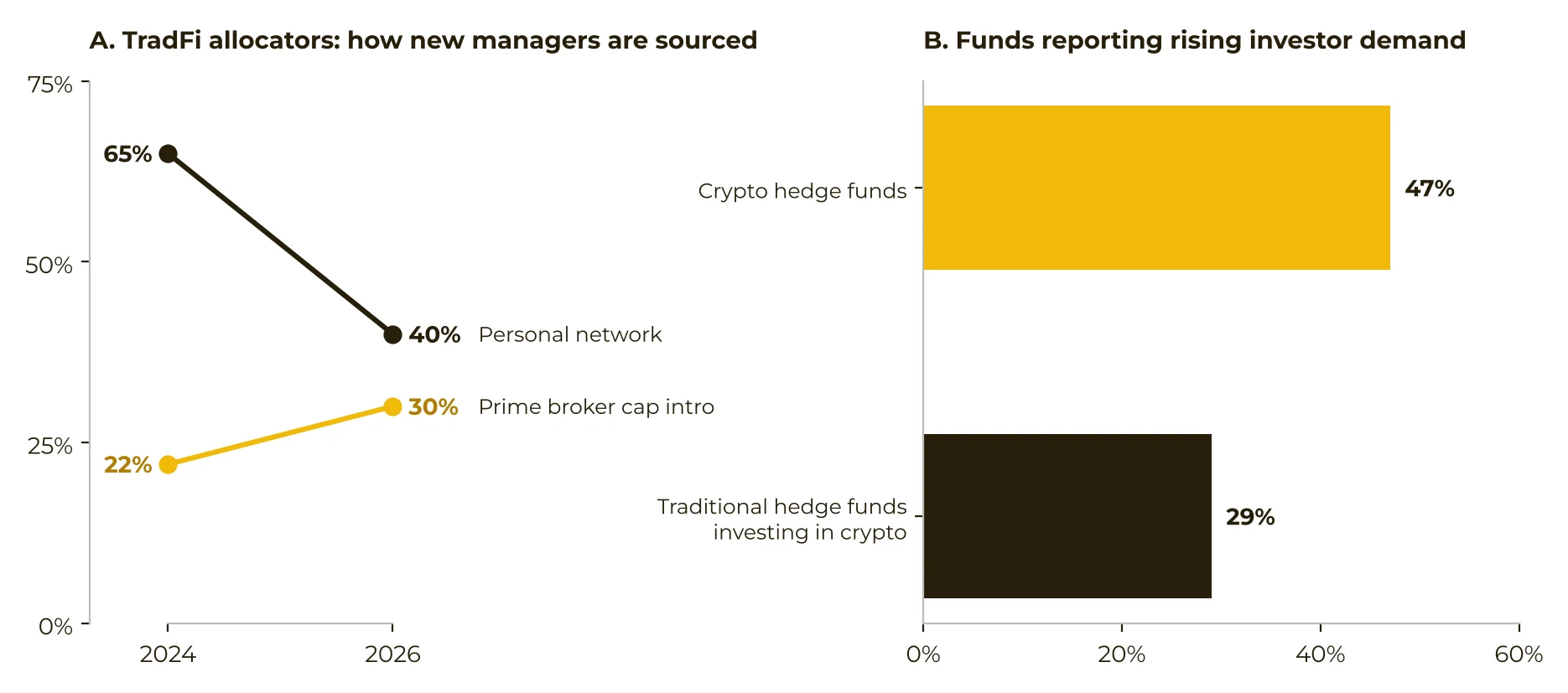
Discovery was still mostly informal
For traditional finance, an AIMA and Marex emerging-manager survey is cited as evidence that manager search was becoming more channeled. Allocators’ reliance on personal networks fell from 65% in 2024 to 40% in 2026, while the share using prime-broker capital introduction rose from 22% to 30%. The note says crypto still lacked an equivalent standard path and still depended heavily on Telegram groups, offline conferences, and personal referrals. Without a shared disclosure and benchmark frame, investors could not compare managers on the same terms, and institutions had difficulty checking audited financials, custody arrangements, and service-provider qualifications. The note does not quantify how much capital those informal channels actually moved.
Demand was not uniform across fund types. 47% of crypto hedge funds said investor demand was rising, compared with 29% of traditional hedge funds that were involved in crypto. Family offices and high-net-worth individuals remained the main backers of crypto funds. Only one in five crypto hedge funds listed pensions, endowments, or sovereign wealth funds as a primary investor type, up from one in nine a year earlier. That is a share of funds naming an investor type, not those institutions’ share of all crypto assets.
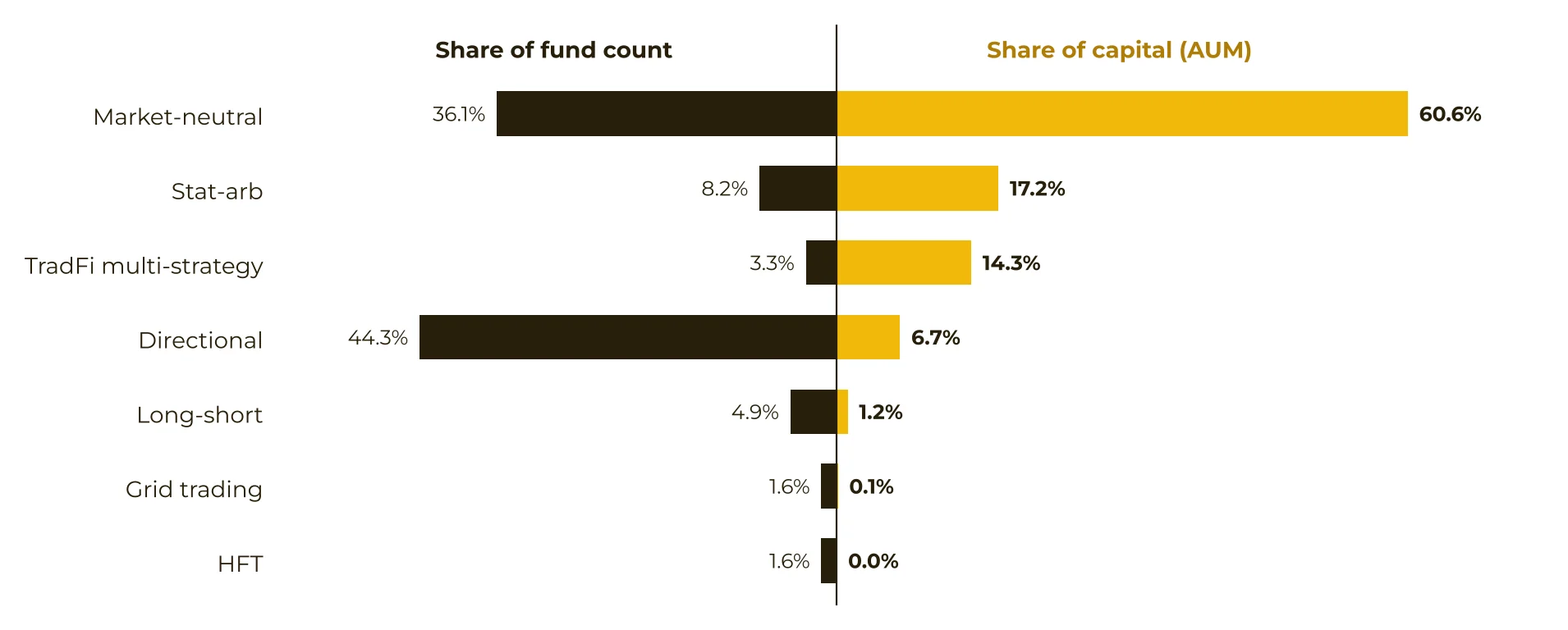
On one platform, fund count and capital diverged
Capital Connect is described as Binance’s regulated discovery and allocation platform, where listed strategies disclose publicly and results are measured on a common standard. The shares below are platform figures as of October 31, 2026, not an industry census.
Neutral-strategy funds were under half of funds by count but held 92.1% of platform capital. Broken out in the body of the note, market-neutral, statistical-arbitrage, and traditional-finance-style multi-strategy funds together held that 92.1% of AUM, with multi-strategy alone at 14.3%. Directional strategies were the largest group by count, at 44.3%, and only 6.7% of platform AUM. Average ticket size for neutral strategies was about 11 times the average ticket for directional strategies. The authors read that mix as allocator preference made visible, not a preference created by the discovery layer, and not a result that simply follows from which strategy has more funds.
Participation here means investor counts on the platform, not addresses. Market-neutral participation rose for two consecutive months and was up 30% cumulatively since May. Statistical-arbitrage participation more than doubled over the same span and stayed stable through October. The note’s contrast is that many longer-tail managers were offering directional products while platform capital sat in hedged strategies.
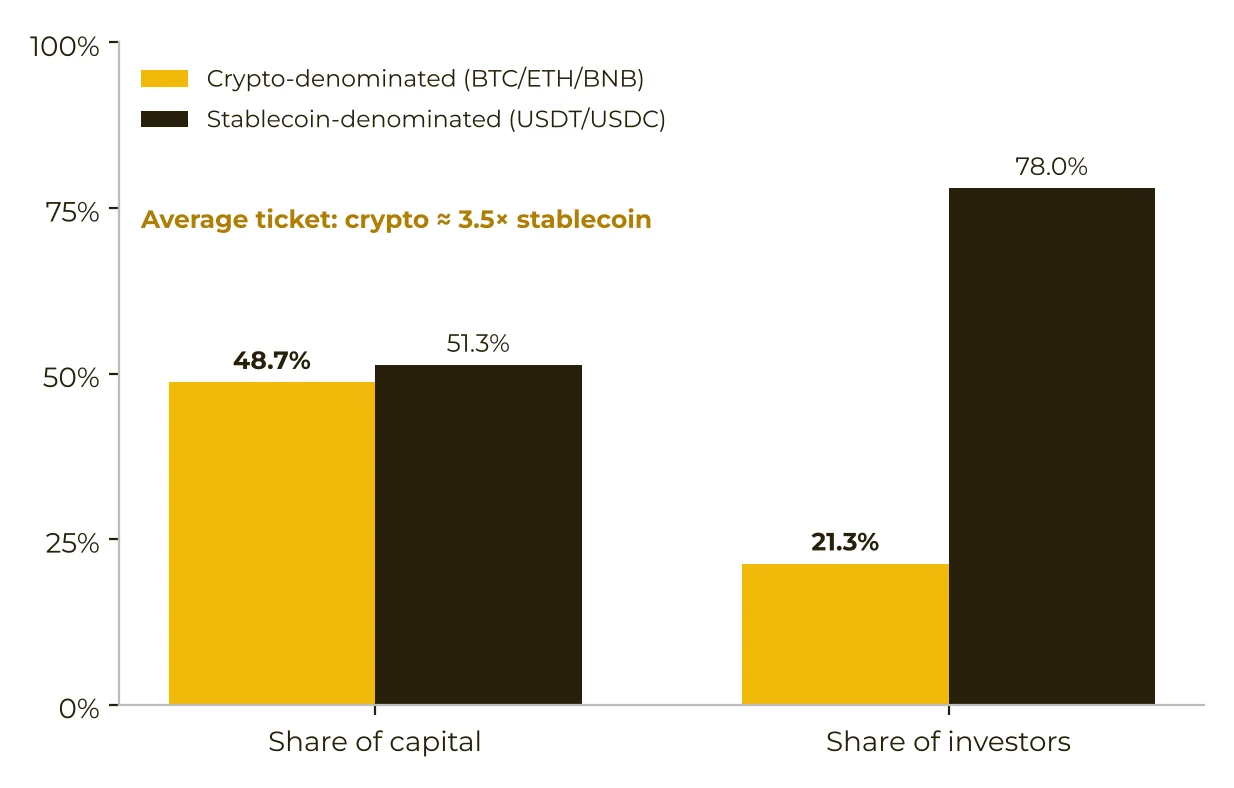
Two mandate types met the same October window
The crypto-native book was large in dollars and narrower in headcount. Funds denominated in BTC, ETH, or BNB held 48.7% of platform capital and about one-fifth of investors, with an average ticket about 3.5 times that of stablecoin-denominated funds. Allocators kept exposure to the underlying coin and outsourced the hedge. In October, coin-denominated physical holdings were described as stable, while the pullback in dollar AUM mainly followed the bitcoin price. That is a valuation move, not evidence that users arrived or left.
The convergent book was smaller and more selective. Traditional-finance-style multi-strategy was still third by capital, at 14.3% of AUM. Its investor count fell 14% month over month in October, from 21 to 18. The authors call this maturation rather than a reversal: institutions would use familiar product structures, but still screened, and some stepped back even when returns were described as steady. A change from 21 to 18 investors is a handful of names on one platform, not a retention rate for crypto as a whole.
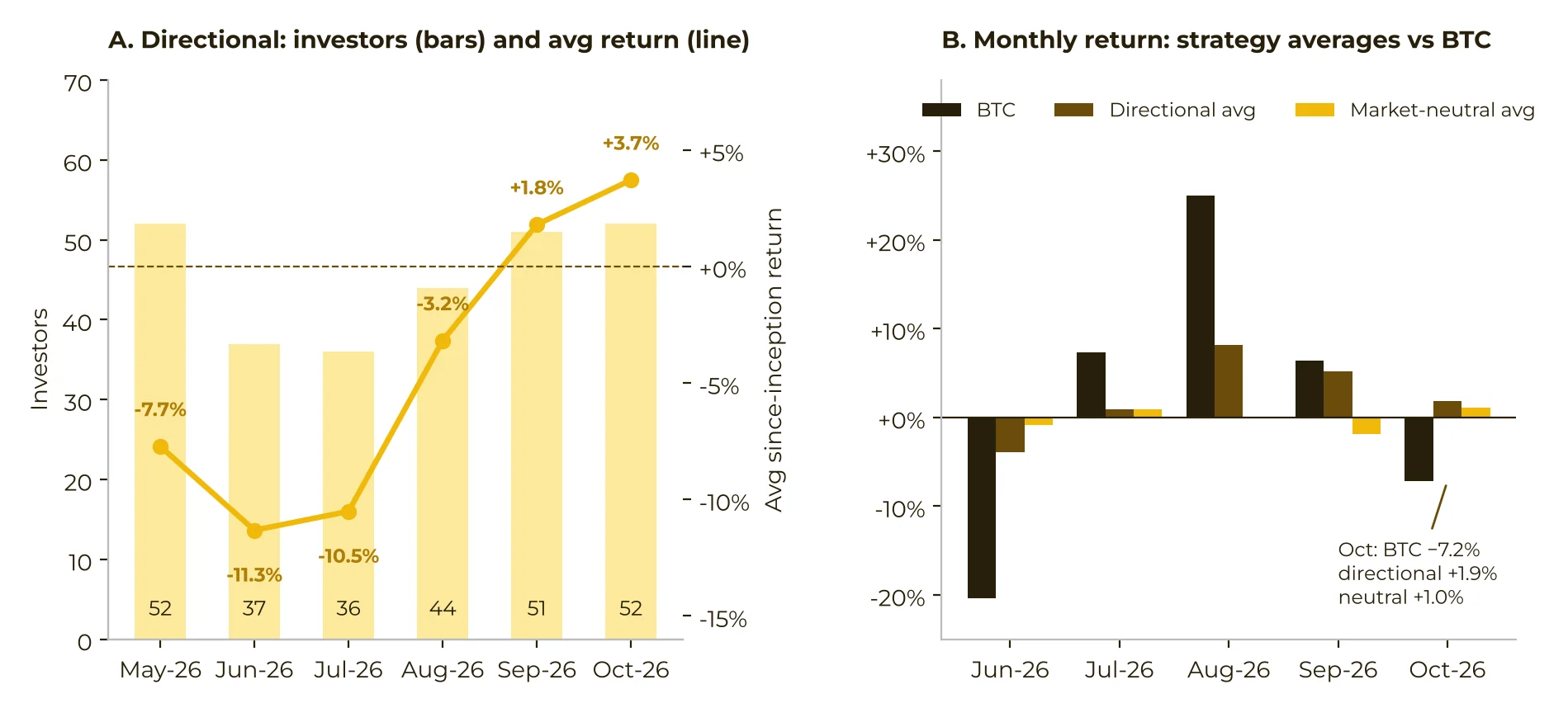
Directional participation returned to a May baseline, with a wide results gap
In the directional sample, investor count fell sharply after returns bottomed in June, reached a low of 36 in July, and recovered to 52 in October, the same level as May. Average since-inception return for directional funds improved from −11% in June to +3.7% in October. The source labels strategy returns as a simple average of fund net asset values, not a capital-weighted index.
October was described as the first live test of that recovery. Bitcoin fell 7.2% — the note also summarizes the month as a 7% decline — while directional funds averaged +1.9% for the month and market-neutral funds averaged +1.0%. Interviews described a repeated behavior: allocators tended to cut directional exposure during drawdowns and add again after volatility and liquidity settled. The published text does not say how many allocators were interviewed, so that pattern is not a measured share of institutions.
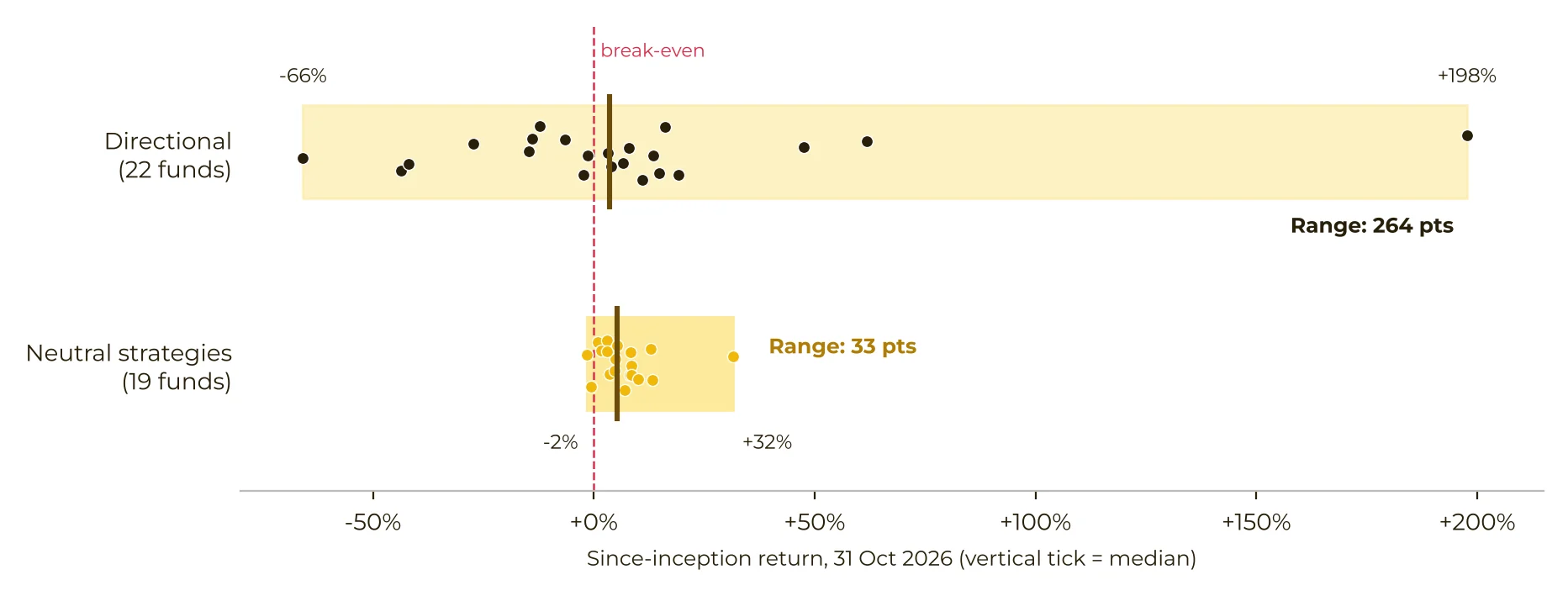
Dispersion is the constraint on reading +1.9% as a strategy-wide result. The gap between the best and worst directional funds was about eight times the gap among neutral strategies. The directional median was around +4%, and only 55% of directional funds were positive, against nine in ten neutral funds. The top quarter of directional funds averaged +69% since inception, and allocators told the researchers they would still pay for that level of result if drawdowns stayed controlled. A top-quartile since-inception average is not a forecast and does not show that those investors remained. The distribution comparison excludes dormant funds and funds with AUM below $1,000; “neutral” in that comparison covers market-neutral, statistical arbitrage, and traditional-finance multi-strategy.
Interviews ranked verifiability above the return print
The interviews, dated October 29 to November 1, 2026, covered Capital Connect allocators and trading teams that run funds. The article does not publish the number of interviews.
What it does publish:
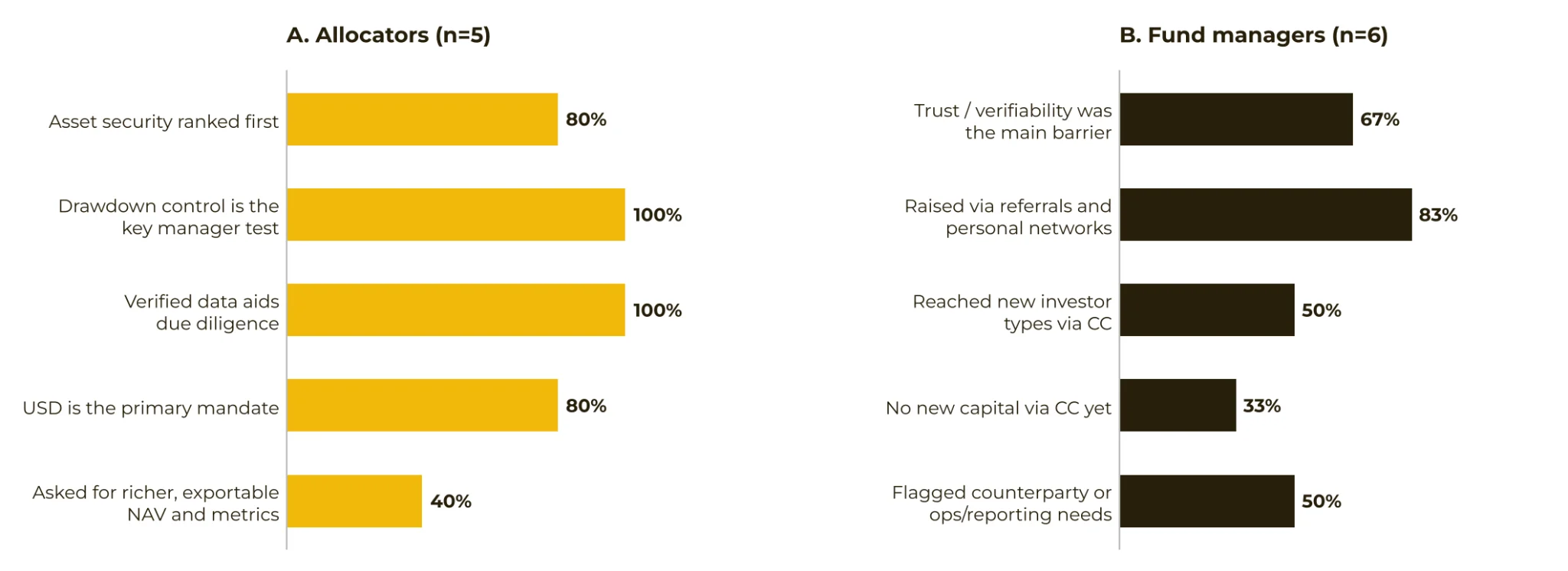
- Every interviewed allocator said verified exchange-internal data could materially strengthen due diligence.
- 80% of respondents ranked asset security first, above historical performance and institutional reputation.
- Allocators looked harder at drawdown control than at headline returns.
- Managers described the binding fundraising constraint as trust cost, not an insufficiently bright return. Track records were hard to cross-check, and KYC, AML, and counterparty compliance review slowed raising capital, so most money still depended on personal referrals.
- After listing on the platform, some managers said they could reach a wider investor set, compliant institutions, and pools gathered from smaller tickets.
The authors’ summary of both sides is that verifiability opened trust and that operating infrastructure could widen the channel. That is interview judgment attached to one platform. It does not show that active funds will approach ETF scale.
What could stall or reverse the pattern
The same snapshot points to limits that do not depend on a price story.
- The 73% planning to raise allocation, and the 60% planning to exceed a 2% sleeve, can stay inside registered spot products. The nearer measured preference is the 81% who wanted compliant spot exposure.
- The 92.1% concentration in hedged strategies is a Capital Connect mix as of October 31, 2026. It can change if listing rules, disclosure, or ticket minimums change. It is not every crypto hedge fund.
- Directional participation back at 52, after a drop to 36, is a return to this sample’s May level. One month in which bitcoin fell 7.2% and the average directional fund was +1.9% does not establish retention.
- An eightfold wider best-to-worst gap means the word “directional” covers funds an allocator can refuse even while the average is positive.
- Pensions, endowments, and sovereign funds were a primary investor type for only one-fifth of crypto hedge funds. If that share stops rising, the LP base remains family offices and wealthy individuals.
Binance Research states that the report is not a forecast, an offer, or a recommendation to buy or sell any trading product, cryptocurrency, or strategy; that its wording is not a legal opinion or Binance’s corporate position; that figures were current as of the stated dates and may change; and that any forward-looking statement may not occur.
Original article, published November 11, 2026, at 20:29 (UTC+8): PANews.