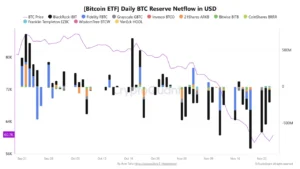
At the time of reporting on Nov. 26, 2026, at 03:21:09 (UTC+08:00), U.S. spot Bitcoin ETFs had recorded $4.94 billion in net withdrawals for November through Nov. 24, already $430 million above the previous monthly record set in June. Bitcoin futures open interest, by contrast, rose by 13,200 BTC on Nov. 24 as the price fell 2.4%. In its Nov. 25 update, Bitfinex Alpha said the evidence pointed to leveraged futures traders buying into the decline rather than buyers accumulating Bitcoin outright.
ETF withdrawals slow after three sessions above $500 million
BlackRock’s iShares Bitcoin Trust accounted for 84% of November’s net ETF withdrawals through Nov. 24. Daily net outflows exceeded $500 million for three consecutive trading sessions, reaching $569.7 million on Nov. 23. They slowed to $231.4 million on Nov. 24, the first reading below $300 million since Nov. 17. The slowdown still left investors withdrawing more than they put in.
Strategy, a regular spot buyer, purchased 457 BTC for $29.6 million in the week through Nov. 22. Over the same period it spent $211.8 million repurchasing its STRC preferred stock, about 7.2 times its Bitcoin spending.
Bitcoin gives back its gains while tech stocks rally
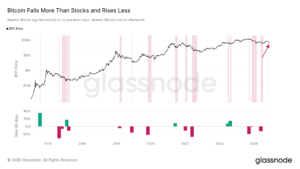
Bitcoin reached $64,673 on Nov. 23 after Nvidia reinstated Jensen Huang as chief executive. Within six hours, Bitcoin was back at its pre-announcement level, while Nasdaq 100 futures still held a 3.1% gain. The Nasdaq Composite finished up 6.5%, its largest gain since April 2025, and the Nasdaq 100 rose 6.9%. Bitcoin settled at $61,300, down 0.1% on the day, and touched $59,312 the following session.
Bitfinex compared returns across the 35 trading days after the Nasdaq 100 peaked on Oct. 6. On days the index rose, Bitcoin gained 0.49% on average against 1.67% for the index, a gap of 1.18 percentage points. On down days, Bitcoin lost 1.87% against the index’s 1.73% decline, a much narrower gap of 0.14 points.
Bitfinex Alpha told crypto.news it interpreted the pattern as holders using equity rallies to sell at a loss or near breakeven. On-chain data showed that coins held for less than 155 days were moving at a loss in aggregate. That profitability measure remained below breakeven for a 19th consecutive day on Nov. 24, though losses had narrowed since Nov. 20.
What the futures data say about demand
Alongside the Nov. 24 rise in open interest, funding rates on the largest venues were positive at an annualized 6% to 8%: traders holding long perpetual futures were paying those holding shorts. It was the combination of rising open interest and positive funding, not the increase in contracts alone, that Bitfinex cited as evidence of leveraged buying.
The buildup was smaller than on Nov. 13, when open interest reached a monthly high of 712,900 BTC and funding was also positive. The next day, $531 million in long positions were liquidated. When a decline leaves traders unable to meet margin requirements, forced closures of leveraged longs can add selling pressure.
Bitfinex identified three signs it would look for before concluding that spot buyers were returning: three consecutive sessions of ETF inflows, Bitcoin holding above $61,300 and short-term holders returning to breakeven.
Options hedging ahead of the Nov. 27 expiry
Bitfinex estimated that options dealers’ hedging could amplify price swings between $58,000 and $64,000 but absorb some selling between $56,000 and $58,000. Its base case was a range of $56,300 to $61,400 into the Nov. 27 expiry, with downside risk toward the Nov. 21 low of $55,501. The expiry covered $6.6 billion in options and was scheduled for 08:00 UTC, the morning after U.S. Thanksgiving.
The Dec. 11 expiry, following the Federal Reserve’s Dec. 9 rate decision, implied a wider range of $52,200 to $65,600. It was the first expiry in Bitfinex’s report with a lower bound below Bitcoin’s realized price of about $53,200, an estimate of the average price at which circulating coins last moved on-chain. Those ranges reflected options pricing and Bitfinex’s analysis, not observed outcomes.