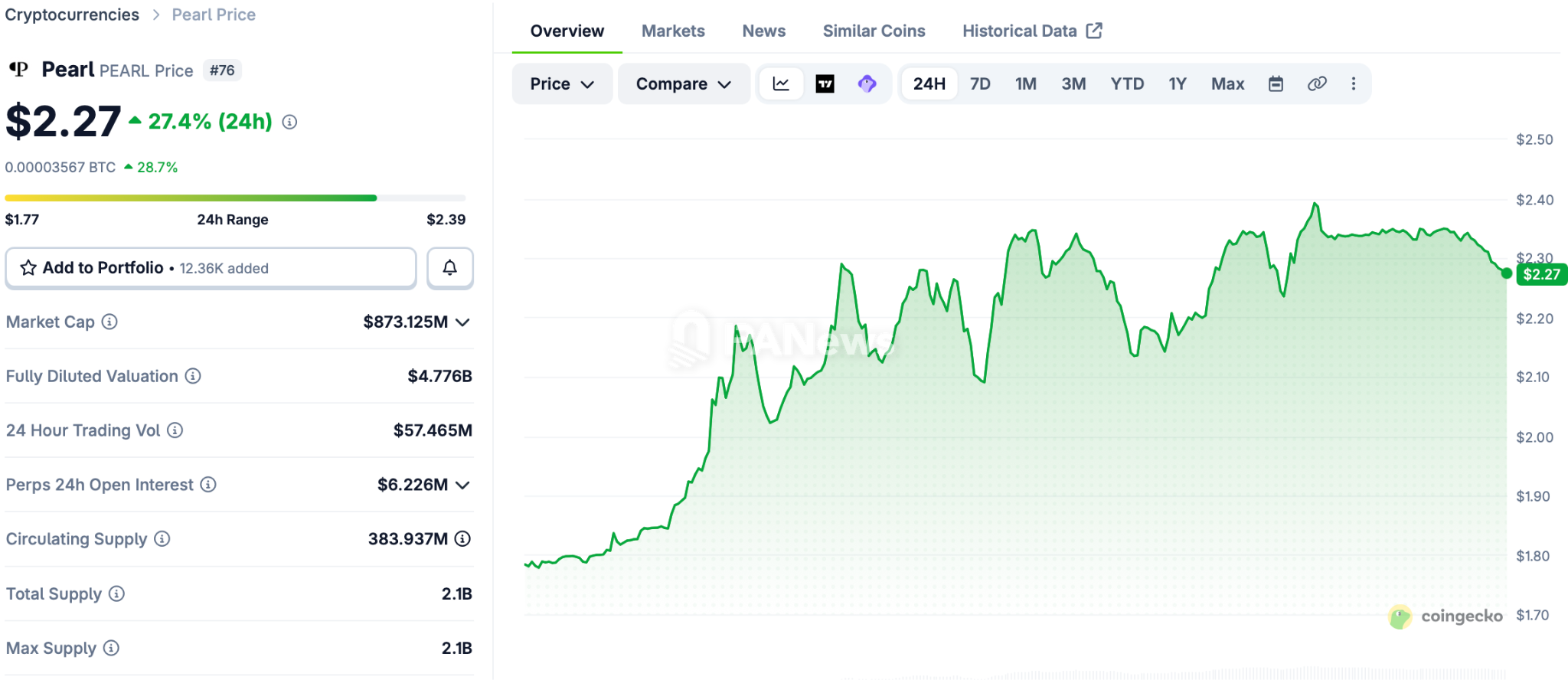
As reported on November 19, 2026, Pearl’s PEARL token had risen about 28% over the preceding 24 hours, according to CoinGecko, approaching its October 21 record of $2.44. The report linked renewed attention to Coinbase and Kraken listings, a disclosed large holding by Syncracy Capital, and the launch of testing for Pearl’s FP8 upgrade. Those developments do not, on their own, establish what caused the price move—or whether Pearl has attracted durable AI-computing demand.
Pearl’s central proposition is duplex proof of work: matrix calculations performed for AI inference could also help compete to produce blockchain blocks. If commercial inference providers can do both with little additional cost, AI-service revenue could cover GPU and electricity expenses while mining provides additional income. That is the proposed model, not a demonstrated network-wide outcome.
Why FP8 matters
Before the upgrade, Pearl’s mainnet accepted proofs using INT7 arithmetic, while the report says commercial AI inference commonly uses lower-precision floating-point formats. Converting workloads to meet the old requirement could slow model service. The FP8 upgrade, described as the PIP-3 proposal, had been activated on testnet—not completed on mainnet at the time of reporting. It aims to make mining more compatible with AI data-center workloads.
That change comes with a hardware trade-off. Because differences in FP8 rounding can prevent chips from producing exactly matching results, Pearl’s supported hardware for the upgrade was limited to Nvidia’s Hopper and Blackwell generations, including the H100, B200 and RTX 50 series. Older Nvidia cards and AMD and Intel chips were excluded under the reported plan.
The distinction between AI-compatible computation and actual AI use remains crucial. The report cites a Blockworks estimate that, before the upgrade, fewer than 1% of blocks matched real AI models. Miners could instead calculate random matrices to compete for rewards. A format change alone cannot show that paying customers will supply a substantial share of mining activity.
What the independent test found
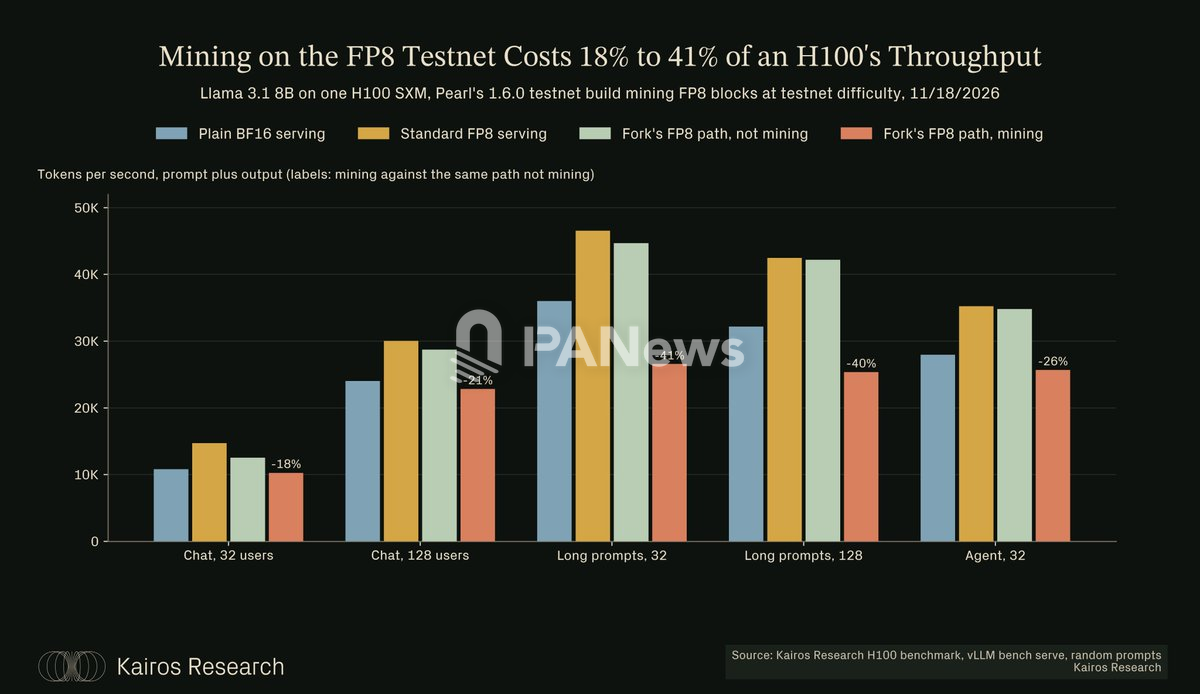
Kairos Research, which the report says holds PEARL, rented an H100 and ran Llama 3.1 8B on the testnet. It reported successfully mining an FP8 block while serving the model. But against the same setup with mining disabled, throughput fell 18%–21% in ordinary conversation, 26% with long agent-style prompts, and 40%–41% in a long-prompt-only scenario. Against standard native FP8 inference, it reported a 24%–48% throughput reduction. Those test conditions do not establish network-wide performance, but they are materially different from the reported official expectation of a 1%–5% inference penalty.
Kairos also reported that effective mining was limited to the prompt-reading, or prefill, phase. In its test, forcing mining during answer generation reduced accuracy on a mathematics evaluation from roughly 87% to 1%. Support for mixture-of-experts models was uneven: it could run OLMoE but could not load the Qwen3 models it tested.
A network transition, not yet an adoption result
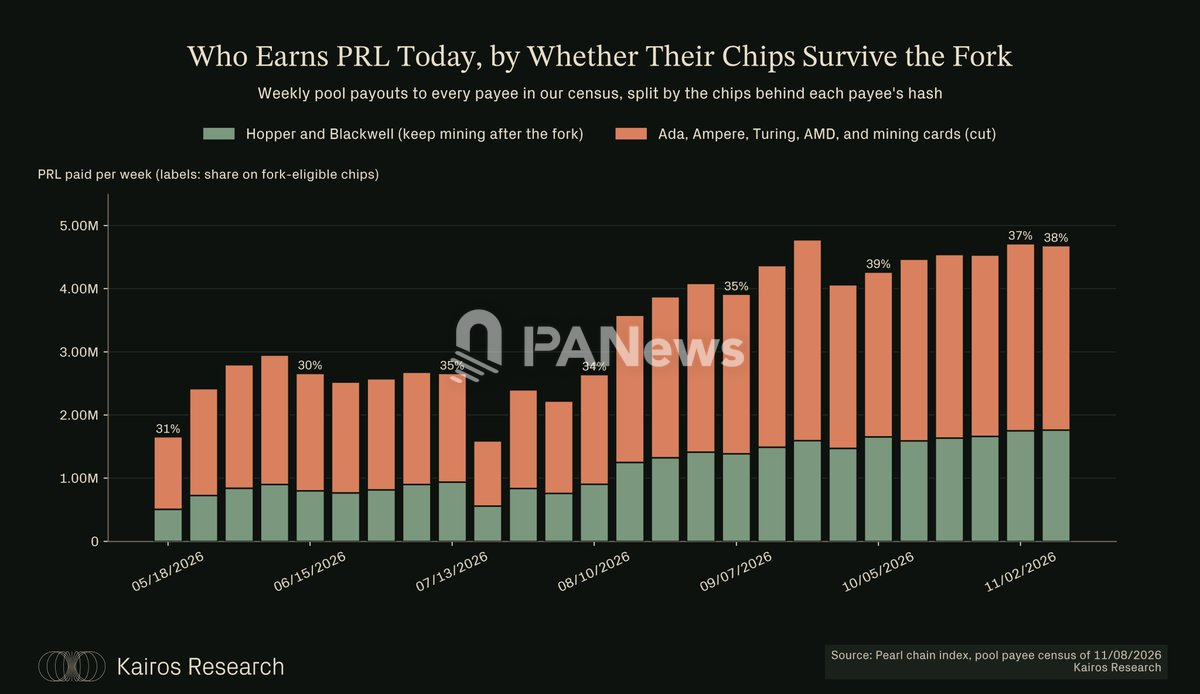
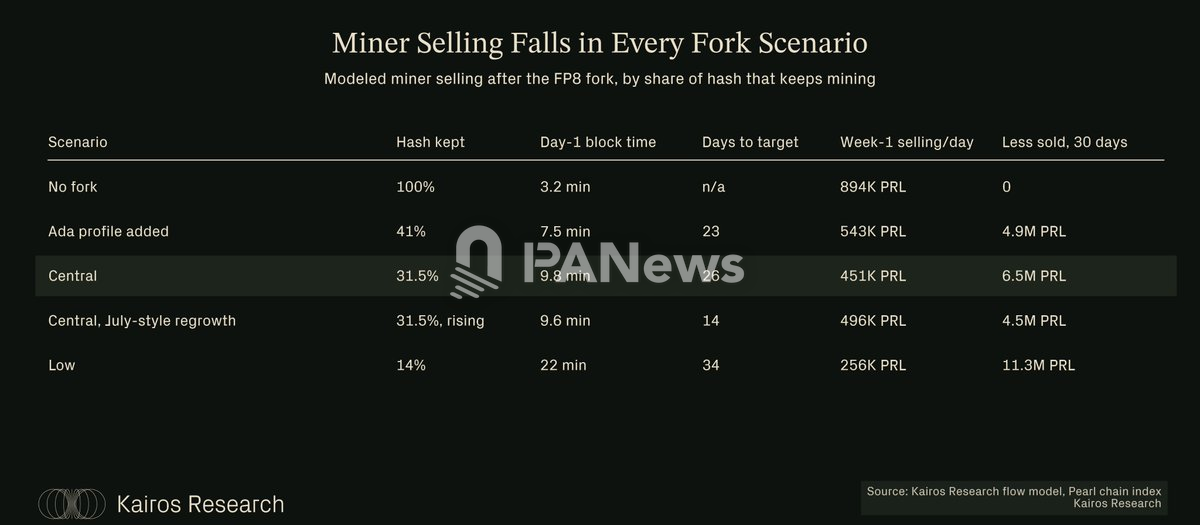
In a survey of six major mining pools covering roughly 24,200 addresses, Kairos estimated that Hopper and Blackwell chips supplied about 37% of network hash power. It projected that a mainnet fork enforcing the proposed hardware requirements could remove roughly two-thirds of existing hash power. An alternative scenario involving Ada hardware would raise its estimated retention rate from about 31.5% to 41%. These are estimates about addresses and computing power, not counts of users or AI customers.
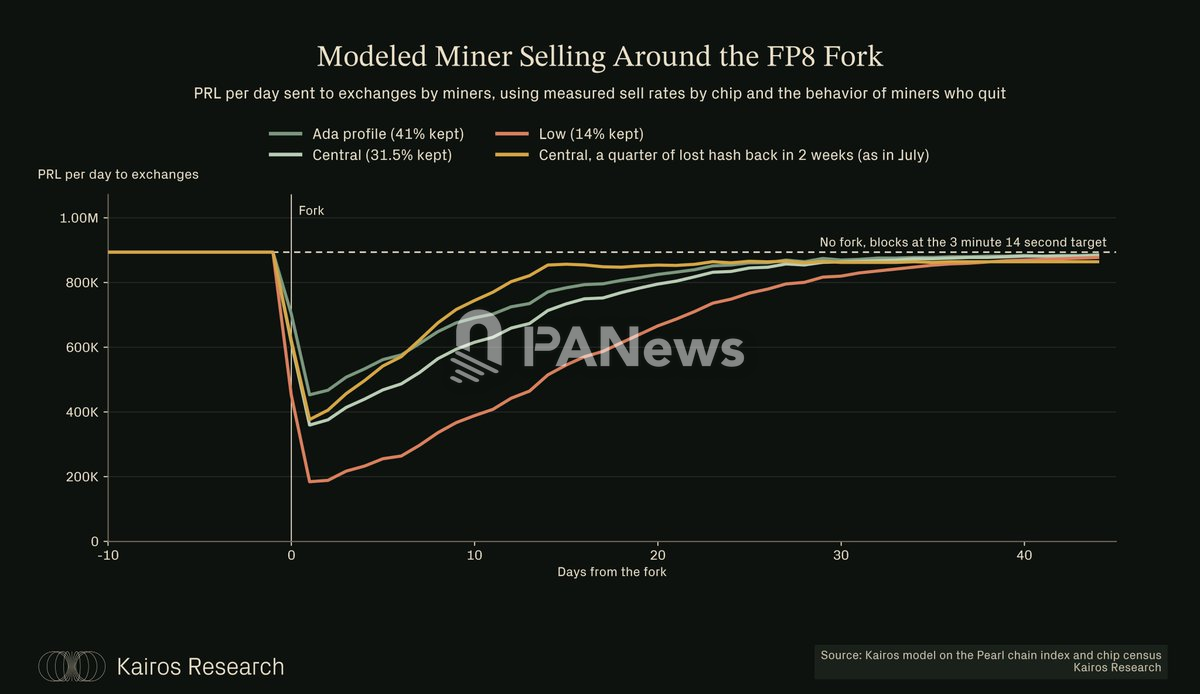
Kairos’s model also projected that slower block production before a difficulty adjustment—estimated at two to five weeks—could reduce miners’ aggregate PEARL sales by about 6.5 million tokens over the first 30 days after the fork, worth roughly $14 million at the price used in the report. Its chain analysis found that miners had historically moved 85%–96% of mining income to exchanges or over-the-counter channels. The projected sales reduction is conditional on the fork and model assumptions; it is not evidence that selling pressure has already fallen.
Other questions concern who benefits if AI use grows. The report says 121.7 million tokens were mined in Pearl’s first six days, about 32% of circulating supply at the cited time, while the company, core team and associated shareholders held 98 million, or about 26%. It reports the project’s stated voluntary lockup of half those holdings until May 2027, alongside criticism that the chain lacks a smart-contract mechanism enforcing it. It also cites $55 million in company equity financing and a $75 million GPU ecosystem fund; token holders do not thereby acquire a claim on AI-inference revenue.
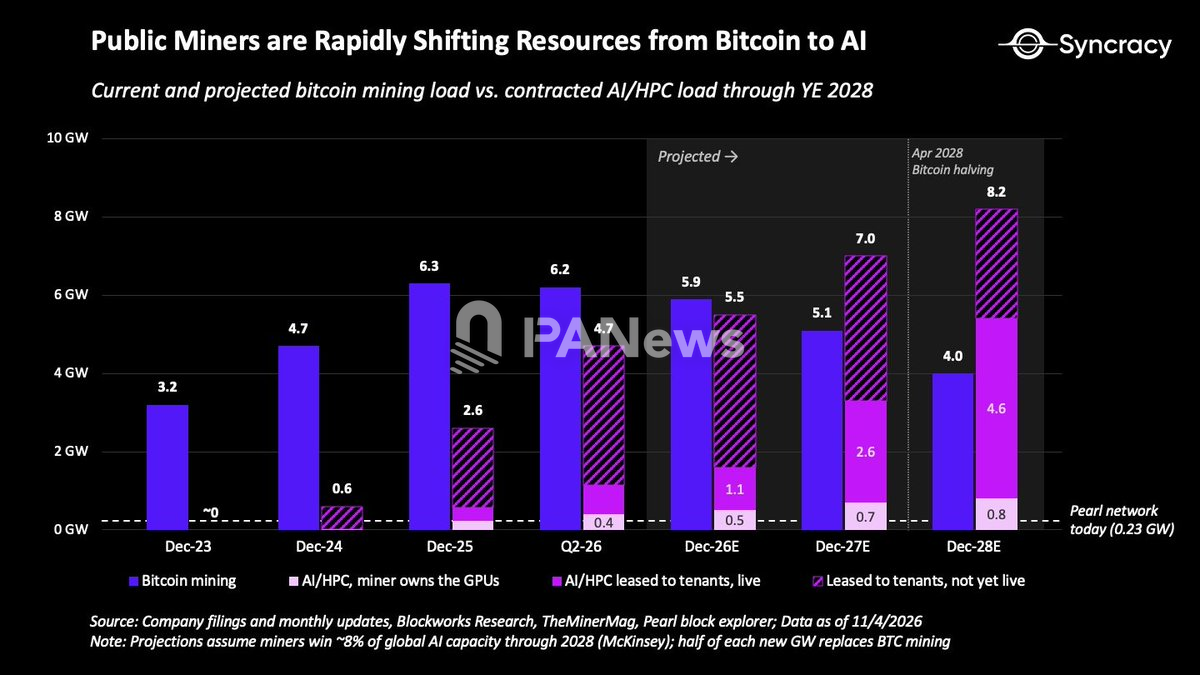
Syncracy Capital has proposed a speculative “P-Day” scenario in which Pearl’s computing and energy footprint surpasses Bitcoin’s. The nearer-term test is narrower: whether a mainnet FP8 transition works, whether inference overhead declines, and whether the share of blocks tied to real AI workloads rises. The November 19 report provides a testnet snapshot and projections, not evidence of sustained commercial adoption.