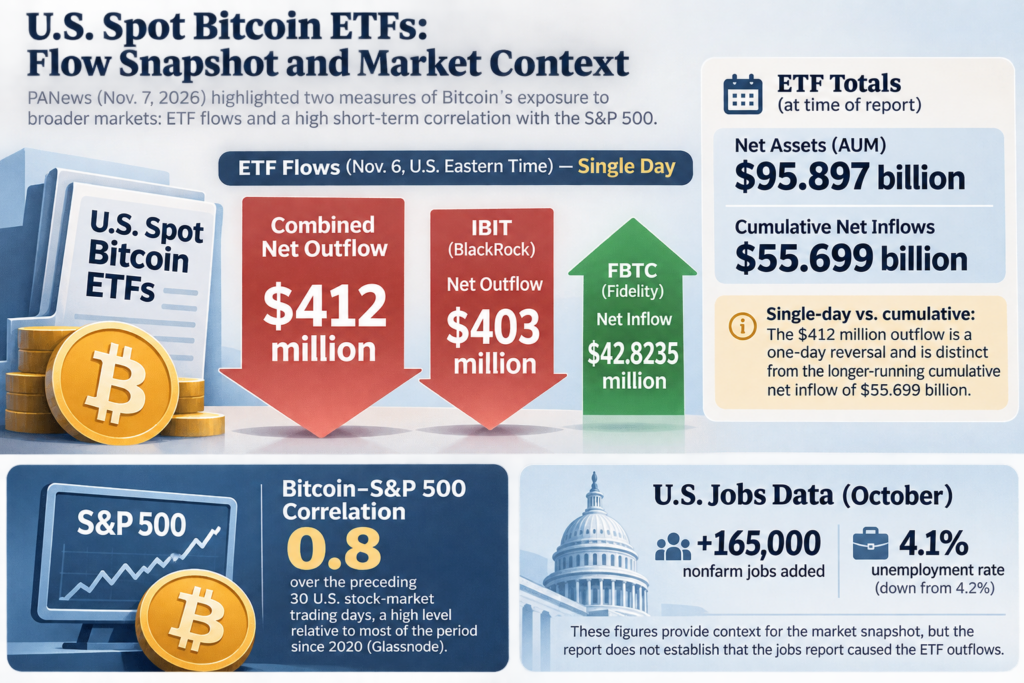
In its November 7, 2026 report, PANews highlighted two measures of Bitcoin’s exposure to broader markets: a daily outflow from U.S. spot Bitcoin ETFs and a high short-term correlation with the S&P 500. Neither measure, on its own, establishes a lasting change in investor behavior.
ETF flows. Citing SoSoValue, the report said U.S. spot Bitcoin ETFs recorded a combined $412 million net outflow on November 6, U.S. Eastern Time. BlackRock’s IBIT had the largest net outflow, at $403 million, while Fidelity’s FBTC had the largest net inflow, at $42.8235 million. At the time of the report, the funds held $95.897 billion in net assets and had recorded $55.699 billion in cumulative net inflows. The one-day reversal is therefore distinct from the longer-running cumulative figure; it does not show whether investors will continue withdrawing funds.
Broader-market exposure. Glassnode said Bitcoin’s correlation with the S&P 500 reached 0.8 over the preceding 30 U.S. stock-market trading days, a level it described as high relative to most of the period since 2020. That is a rolling relationship between prices, not a measure of how many people use Bitcoin or whether they keep using it.
The report also cited U.S. Labor Department data showing 165,000 nonfarm jobs added in October, versus an expectation of 65,000, and an unemployment rate of 4.1%, down from 4.2%. These figures provide context for the market snapshot, but the source does not establish that the jobs report caused the ETF outflows.