A TechFlow compilation of a Four Pillars weekly, published at 12:52 on November 10, 2026 (UTC+8), is a regulation-and-activity note, not a user census. It does not report wallet counts, monthly active users or retention. Where it does give scale, the metric, denominator and window matter, and a higher token price is not treated here as adoption. Original article: Four Pillars weekly, compiled by TechFlow.
Congressional control changed; a full market-structure statute did not
Four Pillars reported that in the U.S. midterm elections on November 3, Democrats secured control of both the Senate and the House, flipping at least seven Senate seats and adding a net of more than 20 House seats. When the new Congress is seated in January 2027, Democrats would control the legislative agenda and key committees and, for the rest of President Trump’s term, have more room to check his priorities.
The note’s reading is that this weakens the path for comprehensive crypto legislation, especially the CLARITY Act, which was meant to set a federal digital-asset market structure and draw a jurisdictional line between the Securities and Exchange Commission (SEC) and the Commodity Futures Trading Commission (CFTC). The bill passed the House in July 2025, then failed to advance after a Senate procedural vote of 49–50 in September 2025. Bipartisan talks had already stalled on stablecoin yield rewards, DeFi developer liability, and ethics language on officials’ conflicts of interest.
Four Pillars also wrote that Democratic control was expected to increase scrutiny of the Trump family’s crypto businesses. Several Democratic lawmakers had already raised conflict concerns about World Liberty Financial (WLFI), its USD1 stablecoin, and the TRUMP meme coin. Whether the family’s financial interests shaped this administration’s digital-asset policy was described as a likely investigative priority—not as a finding already established in the weekly.
Agency work was still moving. In August 2026 the SEC proposed Regulation Crypto Assets, with a targeted registration exemption for certain token offerings and a conditional safe harbor tied to “investment contract” characterization. In October the CFTC opened rulemaking for a Crypto Asset Trading Regulation (CTX) and a Crypto Asset Market Regulation (CAM), aimed at a dedicated framework for retail crypto-commodity trading.
Four Pillars’ commentary treated the most direct effect as a slower legislative track, not a full reversal of U.S. crypto policy. It noted that CLARITY had already failed to clear the Senate when Republicans controlled both chambers, and that passing the existing text would be difficult under a Democratic agenda without much stronger consumer-protection, illicit-finance and conflict-of-interest provisions. Support for an industry-friendly bill could be cast as benefiting the president’s own businesses, so Congress might shift from broad market-structure reform toward investigations, hearings and tighter conflict guardrails.
The same commentary argued that institutionalization need not stop with Congress. The SEC and CFTC had shown willingness to use existing statutory authority through interpretation, rulemaking and exemptive relief. The limitation it stated is real: agency rules and interpretations are easier to unsettle after a change of administration or commission leadership than a statute, and agencies remain inside their current legal mandates. If current SEC and CFTC leadership held that course, incremental rules—not a revived CLARITY Act alone—were framed as the near-term source of clarity, and only if proposals become final rules that actually open market access.

Single-stock perpetuals: a new access point, with early volume only
On November 3, 2026, the CFTC for the first time cleared the way for perpetual futures tied to single stocks to list on U.S.-regulated exchanges. Under the framework, a CFTC-licensed futures exchange that is also registered with the SEC for security-futures trading may offer contracts that track individual equities. Unlike dated futures, these contracts have no fixed expiry, and a trader can take price exposure without holding the stock. The weekly said similar products had already scaled on offshore crypto venues such as Hyperliquid, while a U.S. listing had been blocked by SEC–CFTC uncertainty. Under the Commodity Futures Modernization Act of 2000, the approved contracts are legally “security futures,” jointly overseen by the SEC and the CFTC.
Reported follow-through was product and volume, not users. On November 5, Kalshi became the first U.S. platform to launch regulated single-stock perpetual futures, initially covering more than 50 companies including Nvidia, Meta and Palantir, and recorded more than $300 million in trading volume early after launch. That figure is early notional volume. The note does not give a unique-trader count, a repeat-use rate or a comparison window long enough to separate a launch spike from retained activity.
Payward, described as Kraken’s parent, was preparing single-stock perpetuals through its regulated exchange Bitnomial, initially aimed at 10 major U.S. equities. Coinbase Derivatives and a Crypto.com-affiliated exchange were also moving toward listings. On October 29, Intercontinental Exchange (ICE), parent of the New York Stock Exchange, announced a strategic investment and partnership with Trade[XYZ], a perpetual-futures platform built on Hyperliquid, with a plan to combine that technology with a U.S.-regulated trading venue and clearing. Separately, Hyperliquid Strategies, a listed company that holds HYPE, was applying for a futures commission merchant (FCM) license to open a compliant path into Hyperliquid’s perpetual market, and disclosed quarterly revenue of $13.3 million. Both the ICE partnership plan and the FCM application were still awaiting regulatory approval.
An industry coalition including Cboe and Citadel Securities had sued, challenging the CFTC’s statutory authority to approve single-stock perpetuals under the existing framework. Four Pillars said that litigation could slow launch timing.
Its commentary treated the decision as larger than one new derivative: perpetuals, which began as a crypto-native tool, were being given a compliant structure inside mainstream U.S. finance, extending a pattern that already included bitcoin perpetual futures approved earlier in 2026. ICE’s involvement was read as a signal that an incumbent exchange saw decentralized matching infrastructure as a strategic input, not only a rival—pairing on-chain matching with regulated clearing, identity checks and compliance. For venues such as Hyperliquid and Lighter, a regulated U.S. market might eventually reach retail and institutional flow previously kept offshore by policy barriers. Hyperliquid’s HIP-3, which lets outside deployers open multi-asset perpetual markets on its infrastructure, was described as already positioned for that. The explicit limit: acceptance of the contract type does not automatically authorize a decentralized exchange to serve U.S. customers. A platform still needs exchange registration, custody, market surveillance and clearing compliance. Competition would turn on fitting existing on-chain infrastructure into that architecture, not only on speed and fees. Lighter was said to face a similar window without a comparable compliance path yet. Longer term, the note suggested perpetuals could become a cross-asset interface—equities, commodities, FX and other assets—and that other jurisdictions might follow if the U.S. market stuck. That is a stated possibility, not an observed adoption series.

Other items in the same weekly
The roundup also recorded, without user or flow totals unless noted:
- A NEAR governance vote passed a proposal to cut the token-issuance inflation cap to 1.6%.
- Binance’s chief financial officer left nine days after the record hack described below. The co-chief executive said the handover had been planned half a year earlier. The weekly reports both the timing and that claim; it does not independently settle the cause.
- Samsung Wallet launched a Solana-based USDC account for U.S. Galaxy users. No account or volume figure is given.
- The Trump administration was further advancing policy intended to clear obstacles to holding crypto assets in 401(k) plans. The note does not report completed allocations or participant counts.
- A Payward-affiliated fund and its clients bought AAVE token positions on the secondary market. No size is stated.
- Bullish Capital and 21Shares ran a bitcoin yield effort on Stacks; the third bitcoin-staking bond sold out. No principal amount is stated.
- Aave Labs acquired the financial-engineering team Avon and continued work on on-chain fixed-rate lending. No deal value is stated.
Korea listings: a mix shift, not a user count
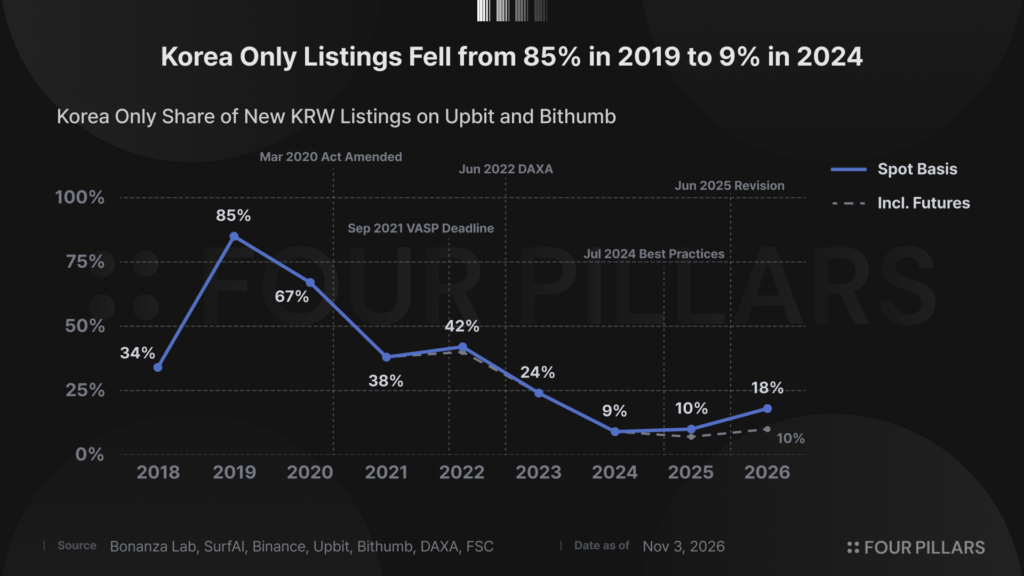
A Four Pillars study cited in the weekly, “How Regulation Reshaped Korea CEX Listings,” tracks what new coins were listed, not who traded them. On Upbit and Bithumb Korean-won pairs, the share of new listings that were listed only in Korea fell from 85% in 2019 to 9% in 2024, and stood at 18% in 2026. The 2026 reading includes regulatory milestone markers. Named sources for the figure are Bonanza Lab, SurfAI, Binance, Upbit, Bithumb, DAXA and the FSC.
The denominator is new KRW-pair listings on those two exchanges, split by whether the asset was Korea-only. It is not trading volume, not addresses, and not a retention rate. A lower Korea-only share is evidence that listing composition changed under regulation. It does not, by itself, show that more people in Korea used crypto, or that the remaining listings were more durable.
The October 30 Binance loss: scale, containment, and what one outflow day cannot prove
Four Pillars’ note “Reflections on the Binance Exploit,” as summarized in the weekly, says that from 5:04 a.m. on October 30, 2026, Binance hot wallets on 10 public chains were breached. Stolen assets totaled $6.36 billion, described as the largest theft of its kind on record. Most of the assets were moved within about 20 minutes. The FBI attributed the incident to the North Korean hacking group TraderTraitor. As with other recent exchange attacks linked to that group, the weekly says the break was not a single private key but the exchange’s internal signing infrastructure.
Within an hour, Tether and Circle froze about $2.4 billion of stolen stablecoins. After the Arbitrum security council and several token teams used admin authority to intervene, more than $2.8 billion of stolen assets had been frozen or recovered as of the report. Binance covered full reimbursement with $6.34 billion raised internally, without external borrowing. Using proof of reserves and a phased reopening of withdrawals from November 1, Binance’s own statistics put first-day net outflows at about 2.1% of total assets. The weekly stresses that this containment depended on Binance’s balance sheet; a smaller exchange hit at the same scale would have been hard-pressed to avoid a run. The 2.1% figure is a one-day, self-reported stock-flow snapshot, not a measure of how many customers left for good.
Of funds that left after withdrawals reopened, about 90% did not go to other top-10 centralized exchanges. The note reads that as rising demand for self-custody. It immediately qualifies the point: recent tampering of Ledger devices and a malicious Trust Wallet update showed that personal wallets are not an absolute refuge, and that repeated thefts and supply-chain attacks increase demand for open-source wallets whose design and internal architecture can be audited. Destination of one outflow wave is not a count of users who stayed in self-custody, and no unique-user or retention figure is supplied.
Hyperliquid’s first half of 2026: revenue, subsidized volume, and a separate price move
The “2026 H1 Hyperliquid Half-Year Report,” written by the Hyperliquid Research Collective (HRC), a joint effort of GLC Research and Four Pillars, is an operating report. It is not a user study.
Protocol revenue in the first half of 2026 was $351 million, up 6.4% year over year. Over the same period bitcoin’s price fell 33% and HYPE rose 155%. Those price moves are reported market results. They are not evidence of more users, and this article does not treat the HYPE rally as adoption. Against the record second half of 2025, first-half revenue was down 38%. The exit from that half improved: June revenue rose to $71 million, the best month since November 2025. The protocol spent $288 million buying back HYPE in the half. The report’s authors said resilient earnings plus ongoing capital return were leading the market to revalue HYPE from operating fundamentals. That is their interpretation of price; the verifiable operating facts are the revenue, the buyback and the comparisons above.
HIP-3 widened what could be traded. First-half HIP-3 volume was $324 billion, 25.1% of the platform’s total matched volume, and that share rose to 32.0% in the second quarter. Listings extended to commodities, equity indices and single stocks. Revenue did not scale with that notional. Because of fee-subsidy pricing, HIP-3 contributed 7.4% of protocol revenue, while native crypto perpetuals still supplied 85.6%. The volume share and the revenue share use different denominators. Turning multi-asset activity into protocol profit was described as the open opportunity. Deployer concentration was flagged in the same breath: in June, Trade[XYZ] alone accounted for 97% of HIP-3 volume.
A USDC yield-calibration mechanism was presented as potential extra return for token holders, not as booked income. At period-end, stablecoin supply on HyperEVM was $5.6 billion, of which 96% was USDC. Under AQAv2, about 90% of reserve interest after cost adjustment would go to the Assistance Fund. At then-current benchmark rates and stablecoin balances, the note estimated an annualized contribution of $135 million to $200 million, a possible buyback pool beyond trading fees. The first-half accounts had not yet recognized that income, and as of publication the actual economic allocation was still to be confirmed. The sensitive inputs named are stablecoin balances, interest rates and the final split.
Holdings are not usage. As of June 30, three U.S. spot ETFs had cumulative net inflows of $309 million. On the report’s definitions, ETFs, listed companies with asset treasuries, and the Assistance Fund together held about 82 million HYPE, 8.2% of total supply. The team claimed only 4.7% of the scheduled unlock amount in the half, which the report treated as a supply-side positive. Against that, $4.3 billion already vested but not yet claimed was called a supply overhang that should not be ignored. No circulating-user or address-activity series accompanies these holding figures.
What the weekly’s market panels cover—and what they do not say
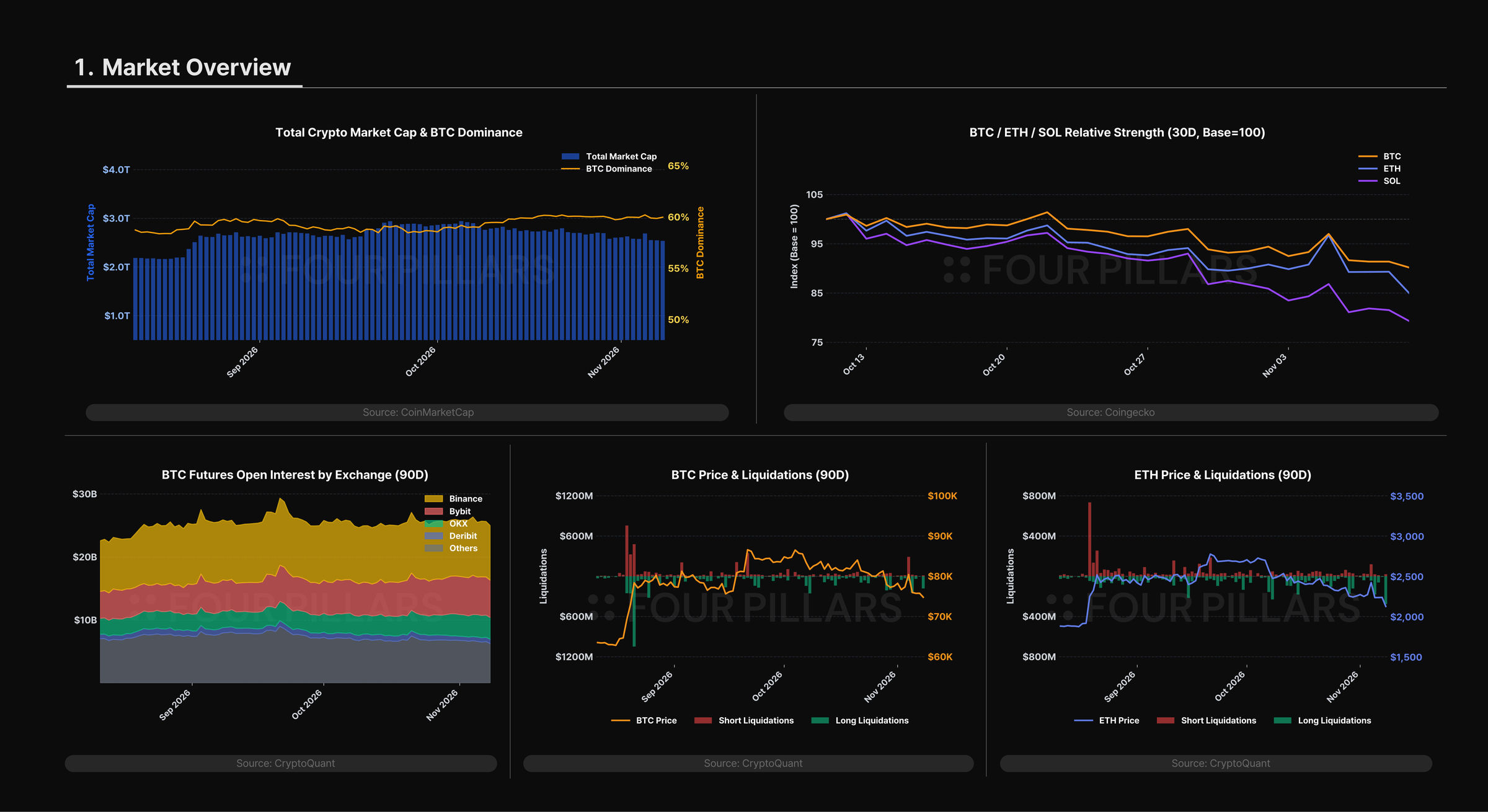
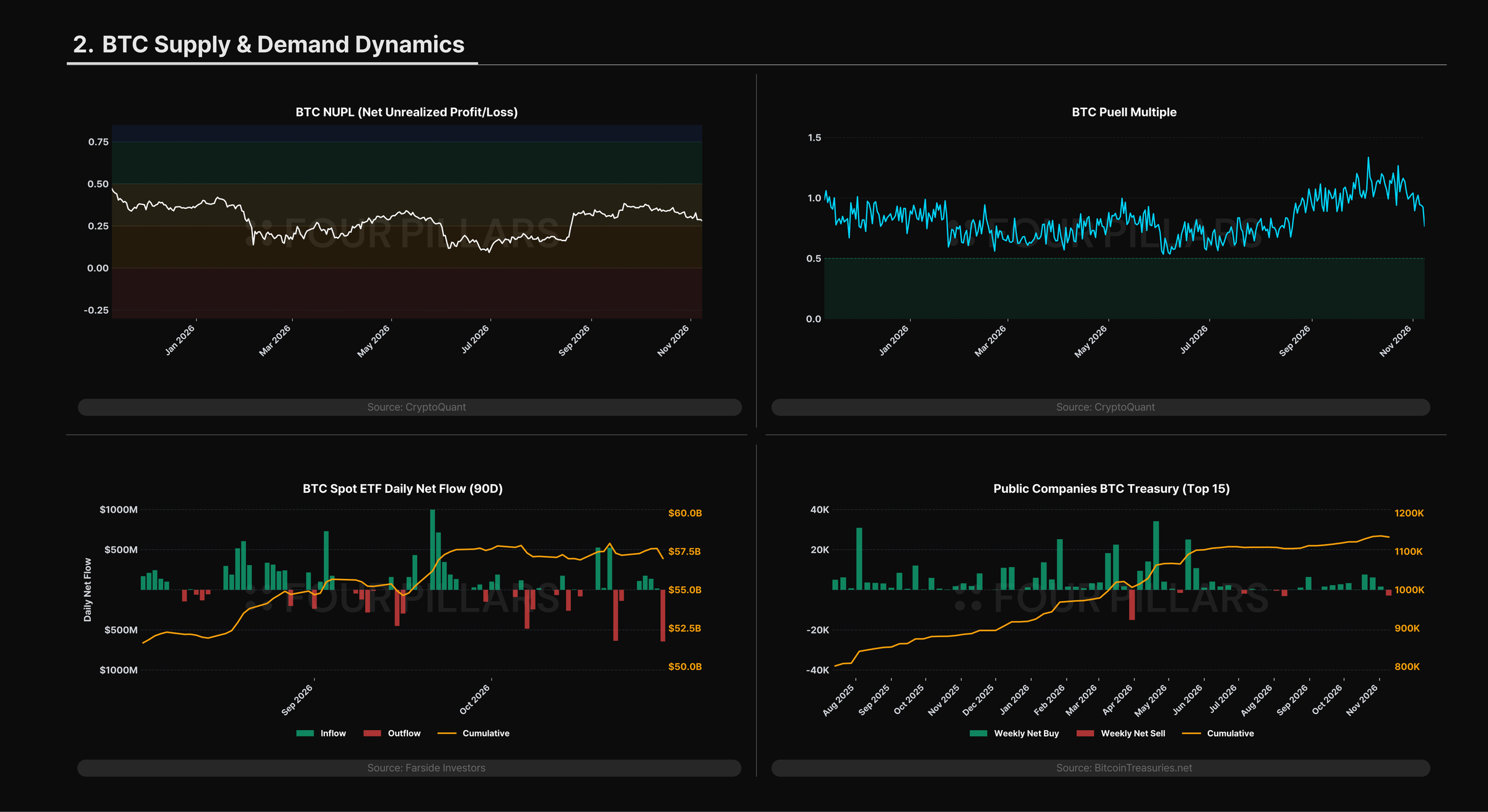
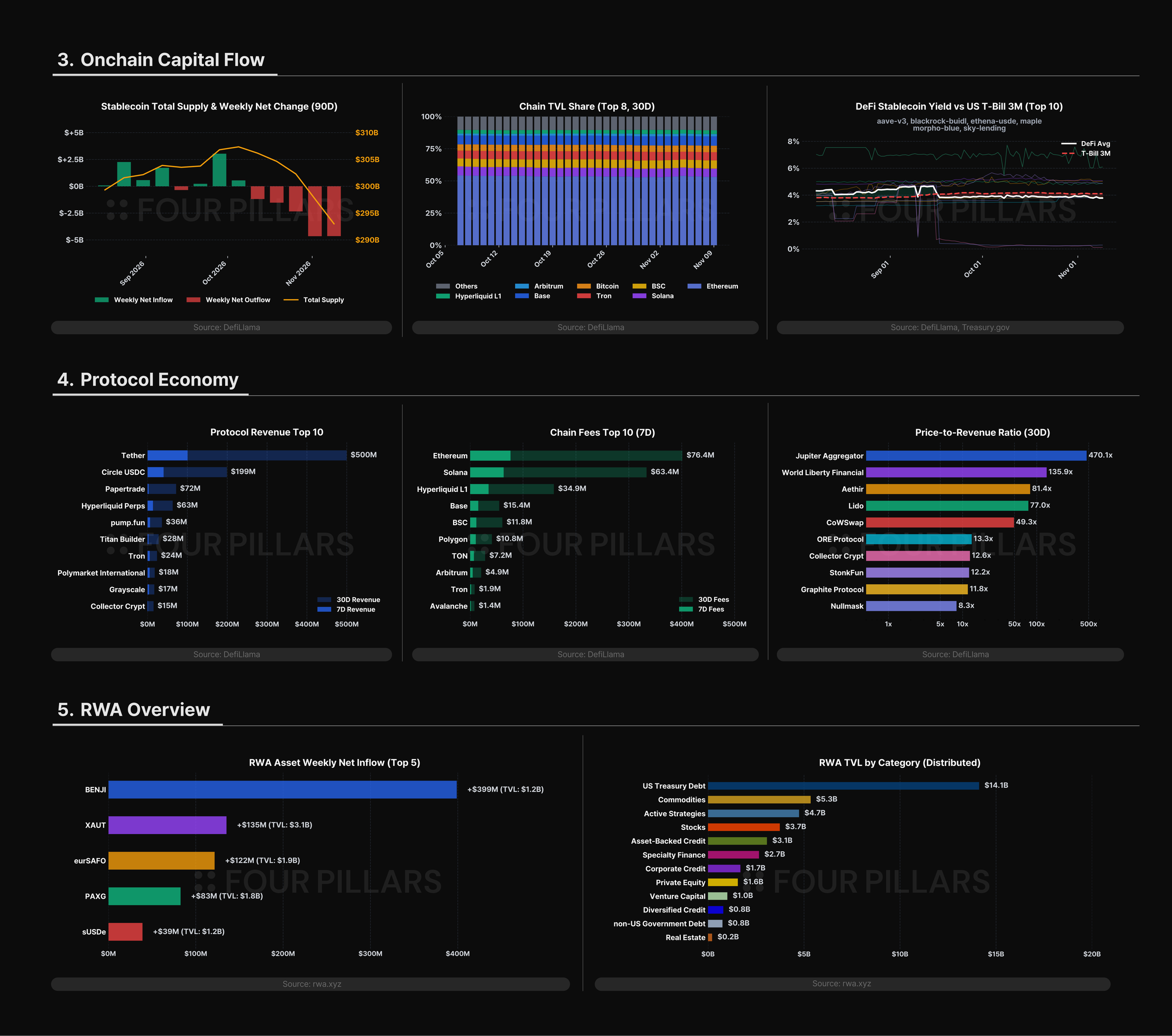
The compilation says the monitoring charts were supported by CryptoQuant data and points institutions to CryptoQuant’s fuller on-chain and market suite. It describes three panels and names sources, but it does not print the underlying readings, so no levels are inferred here.
The market-overview panel covers total crypto market value and bitcoin’s share, 30-day relative strength for BTC, ETH and SOL, 90-day bitcoin futures open interest by exchange, and 90-day BTC and ETH prices with long and short liquidations (CoinMarketCap, CoinGecko, CryptoQuant). The bitcoin supply-demand panel covers NUPL, the Puell Multiple, 90-day spot-ETF daily net flows and cumulative size, and weekly net additions plus cumulative holdings for the 15 largest listed-company bitcoin treasuries (CryptoQuant, Farside Investors, BitcoinTreasuries.net). The third panel covers stablecoin supply and net change, major-chain TVL shares, DeFi stablecoin yields versus the 3-month Treasury, protocol revenue with chain fees and price-to-sales ranks, and weekly RWA net inflows with TVL by category (DefiLlama, Treasury.gov, rwa.xyz).
Opinion titles only
The weekly closes with short comments whose arguments are not reproduced in the compilation text: “No One Needs Blockchain”; why Monad’s quantum approach differs from Ethereum’s; why Mantle was named in Anthropic’s FlashProve, with a discussion of zkSNARKs; and whether Injective SICI could become a “Henry Hub” pricing point for decentralized compute. Those titles are listed only. Nothing in the supplied text supports a summary of their claims.
Published November 10, 2026, 12:52 (UTC+8), as a TechFlow compilation of Four Pillars. Original article.